
Labs · World
Representing a system that changes.
The question
Predicting without knowing the equations.
An installation follows physical laws we do not fully know, and never fully measure. The field has a name: dynamical systems reconstruction, recovering the rule of evolution from the traces a system leaves behind.
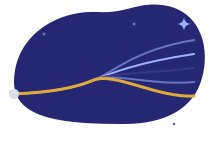
Predicting the next instant is easy. The useful result is a trajectory that stays plausible far ahead, once no measurement comes to correct it.
Yardsticks
What we measure against.
Three references we did not write. A model that does not clear them has learned nothing, whatever else it does.
The Kalman filter
Optimal by construction when the system is known. It cannot be gamed: a method that does not match it on that ground cannot claim to do better elsewhere.
The seasonal naive method
Replaying the previous period as is. Plenty of models fail to beat it, and that is the first cut.
Context parroting
Copying back what just happened. A method that adds nothing to it has memorised without understanding.
Limits
What is not solved.
Size is not enough.
In this family, published work shows that a bigger model is not reliably a better one. The models that hold up are small.
Hidden state stays out of reach.
Recovering what you do not measure, on a system whose equations are unknown: nobody manages it today, ourselves included.
Stability in high dimension.
Over a long horizon a simulated trajectory ends up diverging. We have not measured that properly yet.
The product that depends on it.
Furnace explores thousands of futures of a site. Our world model lets it explore more of them, faster.
Discover Furnace